

So you've been hearing a lot about forex trading lately but you may know How to Open a Forex Trading Account? Maybe a friend mentioned it, or you saw something online about people making money by trading currencies. Now you're curious — but also a little confused about where to even start.
Don't worry. You're in the right place.
Opening a forex trading account is actually simpler than most people think. Yes, trading itself takes time to learn. But setting up your account? That part can be done in a single afternoon. This guide is going to walk you through every step — in plain English, with no fluff.
Let's get into it.
What Is Forex Trading, Anyway?
Before we talk about accounts, let's make sure we're on the same page about what forex trading actually is.
Forex stands for "foreign exchange." It's simply the buying and selling of currencies. When you travel abroad and exchange your dollars for euros, you're participating in the forex market — just at a very small scale.
In the trading world, people do this to make a profit. For example, if you believe the euro is going to rise in value against the US dollar, you buy euros. If you're right and the euro goes up, you sell and pocket the difference.
The forex market is the largest financial market in the world. We're talking about over $7 trillion traded every single day. It runs 24 hours a day, five days a week — from Monday morning in Asia to Friday evening in New York.
That's what makes it appealing to many beginners. You can trade around your schedule.
Read: Best Habits of Successful Forex Traders
Do You Actually Need a Special Account?
Yes, you do. You can't just use your regular bank account to trade currencies on the global forex market. You need a dedicated forex trading account with a broker.
Think of it this way. If you want to buy stocks, you open a brokerage account. Same idea here. A forex broker gives you access to the currency market, provides you with a trading platform, and handles all the behind-the-scenes stuff like executing your trades.
Without a broker and a proper trading account, you simply can't trade forex.
Step 1 — After How to Open a Forex Trading Account and create Choose the Right Forex Broker
This is honestly the most important step. Your broker is like your trading partner. Pick a bad one, and everything else falls apart.
Here's what to look for when choosing a broker.
Regulation is non-negotiable. A regulated broker is overseen by a financial authority. This means they follow rules designed to protect you. In the US, look for brokers regulated by the CFTC and NFA. In the UK, check for FCA regulation. In Australia, look for ASIC. If a broker isn't regulated by anyone, stay away — no matter how good their website looks.
Check the spreads and fees. Every time you trade, your broker makes money through the spread — the tiny difference between the buy and sell price. Some brokers also charge commissions. Before you sign up, understand exactly how much each trade will cost you. Low spreads are generally better, especially if you plan to trade frequently.
Look at the trading platforms they offer. Most brokers offer MetaTrader 4 (MT4) or MetaTrader 5 (MT5). These are the industry standards and are used by millions of traders worldwide. Some brokers offer their own proprietary platforms too. You want something that's easy to use, stable, and has good charting tools.
Check the minimum deposit. Some brokers let you start with as little as $10. Others require $500 or more. Make sure the minimum deposit fits your budget, especially when you're just starting out.
Read reviews — but be smart about it. Look for honest reviews on sites like Trustpilot or forex forums. Pay attention to complaints about withdrawals. If many people are saying they can't get their money out, that's a huge red flag.
Popular beginner-friendly brokers include IG, OANDA, XM, Pepperstone, and Forex.com. These are all well-regulated and have good reputations. That said, always do your own research before committing.
Step 2 — Understand the Types of Forex Accounts
Once you've narrowed down your broker choices, you'll notice they offer different types of accounts. Here's a quick breakdown.
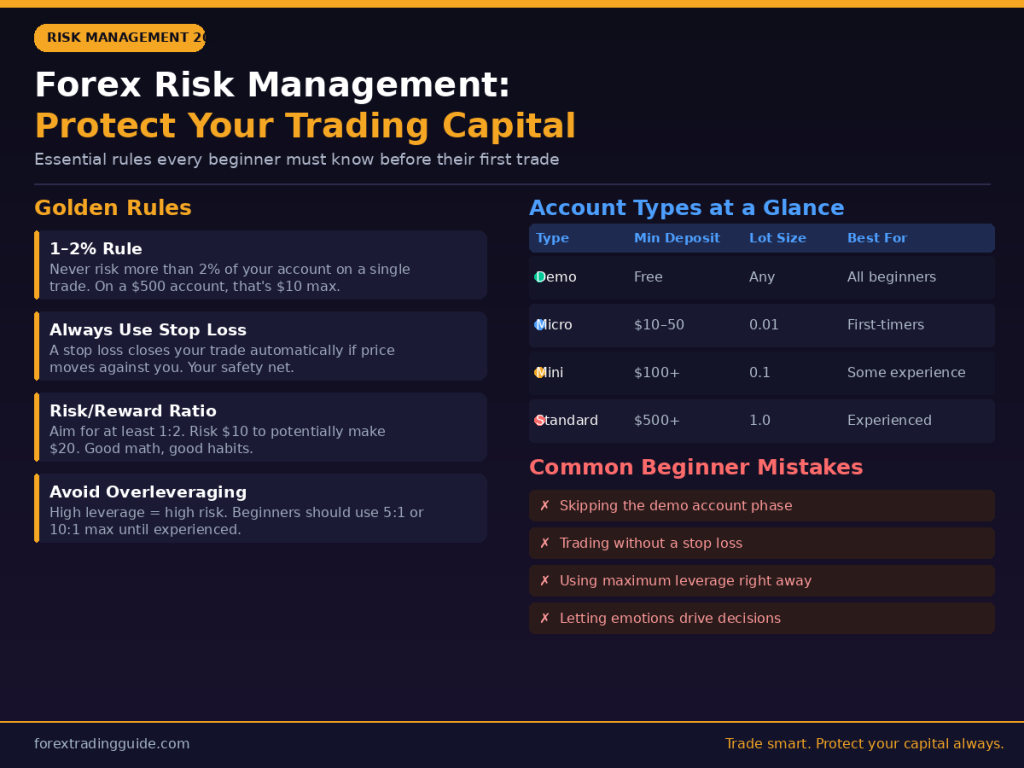
Standard Account. This is the most common type. It's for traders who have some experience and a decent starting capital. Lot sizes are standard (100,000 units of currency), though your broker handles this in the background.
Mini Account. Perfect for beginners. You trade in smaller sizes (10,000 units), which means lower risk. Many beginners start here.
Micro Account. Even smaller than a mini account (1,000 units). Great if you want to start with very little money and get real market experience without risking much.
Demo Account. This is a practice account with fake money. It's 100% free, and it works exactly like a real account. We'll talk more about this in a moment — but if you're a complete beginner, start here.
Islamic Account. Also called a swap-free account. This is designed for traders who follow Islamic finance principles and cannot earn or pay interest overnight.
For most beginners in 2026, the recommendation is simple: start with a demo account, then move to a micro or mini account once you're comfortable.
Step 3 — Open a Demo Account First
If you've never traded before, please start with a demo account. This is not optional advice — it's genuinely important.
A demo account lets you practice trading with virtual money. The prices are real. The market conditions are real. The only thing that's fake is the money. This means you can make all your beginner mistakes without losing a single dollar.
Most brokers offer demo accounts for free, and you can set one up in about five minutes. Just go to your chosen broker's website, click "Open Demo Account," fill in your name and email, and you're in.
Spend at least two to four weeks on a demo account before you trade with real money. Use that time to learn your trading platform, understand how currency pairs work, try different strategies, and get a feel for how the market moves.
Think of it like a driving simulator before you get on the highway. You wouldn't skip that if you could help it.
Step 4 — Register for a Real Account
Ready to open a real account? Here's exactly what to expect.
Go to your chosen broker's website and look for the "Open Account" or "Register" button. You'll be asked to fill out a registration form. This typically takes about 10 to 15 minutes.
You'll need to provide:
Your full name, date of birth, and home address. Your email address and phone number. Your country of residence and nationality. Some basic information about your financial situation — like your annual income, employment status, and net worth. Your trading experience — how long you've been trading, how often you trade, and your knowledge of financial products.
That last part surprises a lot of beginners. But brokers are required by law to collect this information. It's called a suitability assessment. They need to make sure forex trading is appropriate for you.
Answer honestly. If you say you have 10 years of experience and you don't, it won't help you — and it could create legal problems down the line.
Step 5 — Verify Your Identity (KYC) After Know How to Open a Forex Trading Account And Open
After you fill out the registration form, you'll need to verify your identity. This is called KYC — Know Your Customer. It's a legal requirement for regulated brokers worldwide. It's not personal. Every single person who opens a forex account has to do this.
You'll typically need to upload:
A government-issued photo ID — this can be your passport, national ID card, or driver's license. A proof of address document — a recent utility bill or bank statement with your name and address on it. The document should be no older than three months.
Most brokers now have a digital upload process that takes just a few minutes. Some brokers verify instantly using automated systems. Others take one to three business days.
Once your identity is verified, your account is officially open.
Read: What’s the Deal With the Ethiopian Constitution and Forex Trading?
Step 6 — Fund Your Account
Now it's time to deposit money. Most brokers offer several ways to fund your account.
Bank transfer is the most common. It's safe and reliable, but it can take one to five business days. Credit and debit cards are faster — usually instant or within a few hours. E-wallets like PayPal, Skrill, and Neteller are popular too, especially for quick deposits.
Always double-check the minimum deposit for your account type. And never deposit money you can't afford to lose. Seriously — forex trading involves real risk. Start small. You can always add more later.
Once your deposit clears, you'll see the balance in your trading account and you're ready to trade.
Step 7 — Download and Set Up Your Trading Platform After How to Open a Forex Trading Account
Your broker will give you access to a trading platform. Download it to your computer or phone. MT4 and MT5 are available on Windows, Mac, iOS, and Android — so you can trade from pretty much anywhere.
Log in with the credentials your broker sent you. Take some time to explore the platform. Learn where to find:
The currency pairs (called "instruments" or "symbols"). The charts and how to read them. How to place a trade — including setting stop losses and take profit levels. Your account balance and open positions.
If you already have a demo account, this will feel familiar because it's the same platform. That's one of the benefits of starting with a demo first.
Step 8 — Understand Risk Management Before Your First Trade
This is where a lot of beginners get into trouble. They focus so much on "how to make money" that they forget about "how to protect their money."
Here's a simple rule: never risk more than 1% to 2% of your account on a single trade. So if you have $500 in your account, don't risk more than $5 to $10 on any one trade. It sounds small, but this is what keeps you in the game long-term.
Always use a stop loss. A stop loss is an automatic order that closes your trade if the market moves against you by a certain amount. It's your safety net. Without it, one bad trade can wipe out a significant chunk of your account.
Leverage is another thing to understand. Forex brokers offer leverage, which lets you control a larger position with a smaller amount of money. For example, with 50:1 leverage, you can control $50,000 with just $1,000. This sounds exciting — but it works both ways. Losses are also magnified. As a beginner, use low leverage or avoid it until you really understand how it works.
Common Mistakes Beginners Make (And How to Avoid Them) On How to Open a Forex Trading Account
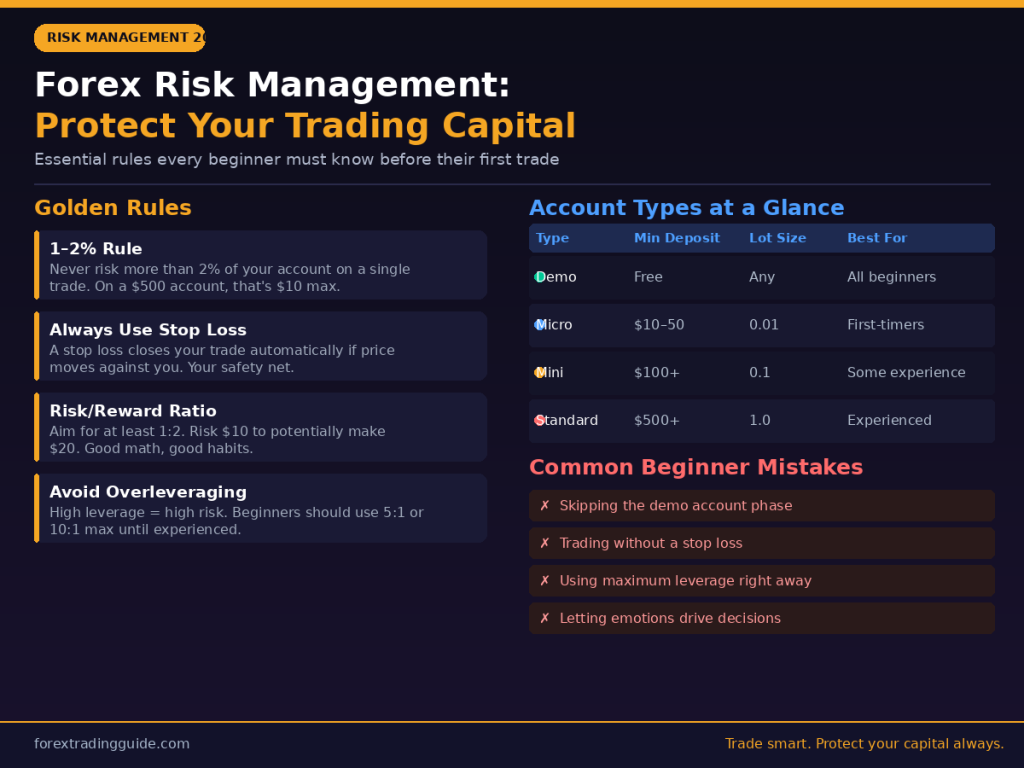
Let's be honest — most beginners make the same mistakes. Here are the big ones, so you know what to avoid.
Skipping the demo account. We talked about this already. Don't skip it. There's no rush.
Overleveraging. Using too much leverage is one of the fastest ways to blow up a trading account. Start low.
Chasing trades. You miss a move and then jump in late, hoping to catch the last bit of profit. This usually ends badly. There will always be another trade.
Trading without a plan. Successful traders have a strategy. They know when to enter, when to exit, and how much to risk. "Winging it" doesn't work in forex.
Letting emotions control decisions. You take a loss, feel frustrated, and try to win it back immediately. This is called revenge trading, and it almost always leads to bigger losses. If you're emotional, step away from the screen.
Ignoring the learning process. Forex trading is a skill. It takes time to develop. Don't expect to be profitable in your first month. Give yourself time to learn, grow, and improve.
How Much Money Do You Need to Start After How to Open a Forex Trading Account Know And Open?
This is one of the most common questions beginners ask. The honest answer is: it depends on your broker and your goals.
Technically, some brokers let you start with as little as $10. But trading with a very tiny account is limiting. A more realistic starting amount for a micro account is $100 to $500. For a mini or standard account, $500 to $2,000 is common.
Remember — start with money you can afford to lose. Forex trading is not a guaranteed income source. It's a skill-based activity with real risk. Treat your starting capital as tuition in the school of experience.
Is Forex Trading Legal and Safe?
Yes — forex trading is completely legal in most countries, including the US, UK, EU, Australia, and many others. As long as you use a regulated broker and follow the rules in your country, you're operating within the law.
That said, there are scams out there. Be very careful of anyone promising "guaranteed profits" or "risk-free returns." That's not how trading works. Legitimate brokers and traders will always tell you that forex involves risk.
Stick to regulated brokers, never send money to someone you don't know, and never let anyone "trade on your behalf" without doing thorough research first.
Final Thoughts On How to Open a Forex Trading Account
Opening a forex trading account in 2026 is straightforward. The technology is better than ever, brokers are more accessible, and there's more educational content available than at any other point in history.
Here's a quick recap of what you need to do:
Choose a regulated broker that suits your needs. Start with a demo account and practice. Open a real account and complete your KYC verification. Deposit a small amount and start with low risk. Learn your platform, study risk management, and trade with a plan.
Forex trading won't make you rich overnight. But with patience, consistent learning, and disciplined risk management, it can become a genuinely rewarding skill — and potentially a meaningful income stream over time.
Read: Open your FOREX.com trading account
Disclaimer: Forex trading involves significant risk of loss. This article is for educational purposes only and should not be considered financial advice. Always trade with money you can afford to lose and consult a licensed financial advisor if needed.