

If you've been trading forex for a while, you already know that spreads can quietly eat into your profits — even when you're making the right trades but if you not familiar with Best Forex Brokers With Lowest Spreads read this article. And if you're just starting out, understanding spreads is one of the most important things you can do before you deposit a single dollar.
In this guide, we're going to talk about everything you need to know about forex spreads — what they are, why they matter, and which brokers genuinely offer the lowest spreads right now. We'll also help you figure out which broker is the best fit for your trading style, whether you're scalping the 1-minute chart or swing trading the daily.
Let's get into it.
What Is a Spread in Forex Trading?
Before we jump into broker reviews, let's make sure we're on the same page about what a spread actually is.
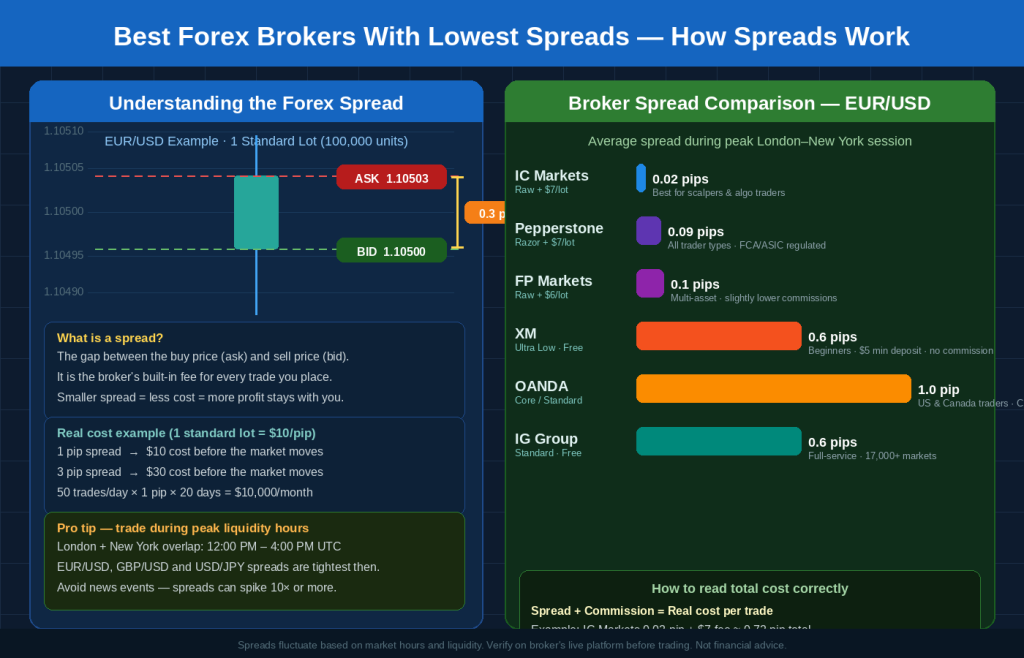
A spread is the difference between the buy price (ask) and the sell price (bid) of a currency pair. Think of it this way — when you go to a foreign exchange counter at the airport, the rate they offer to buy euros is slightly different from the rate they'll sell euros to you. That gap is their profit. In forex trading, the spread is essentially the broker's fee.
For example, if EUR/USD has a bid price of 1.10500 and an ask price of 1.10503, the spread is 0.3 pips. That might sound tiny, but if you're making 20, 30, or 50 trades a day, it adds up fast.
Here's a simple real-life example. Say you buy 1 standard lot (100,000 units) of EUR/USD with a 1-pip spread. That spread alone costs you $10 before the trade even moves. Now imagine paying 3 pips instead of 1 — that's $30 gone before the market does anything. Over a month of active trading, that's a massive difference.
This is why traders obsess over spreads. It's not being cheap. It's being smart.
Fixed vs Variable Spreads — Which Is Better?
This is one of the first things new traders ask, and it's a great question.
Fixed spreads stay the same regardless of market conditions. Whether the market is calm or going crazy during a news release, your spread stays constant. This is great for beginners because you always know what you're paying. The downside is that fixed spreads are usually higher on average than variable spreads during calm market conditions.
Variable spreads (also called floating spreads) change depending on market liquidity. During busy trading hours — like when the London and New York sessions overlap — spreads can be razor-thin, sometimes less than 0.1 pips on major pairs. But during off-hours or around high-impact news events, they can widen significantly.
Most professional traders prefer variable spreads because, during peak hours, they get much better rates. But if you're someone who trades during the Asian session late at night or during major news events, you might want to consider a broker that offers tighter spreads even in those conditions.
The bottom line is that there's no one-size-fits-all answer. Your trading style matters a lot here.
In Best Forex Brokers With Lowest Spreads Why Low Spreads Matter So Much
Let's talk about this from a practical angle, not just theory.
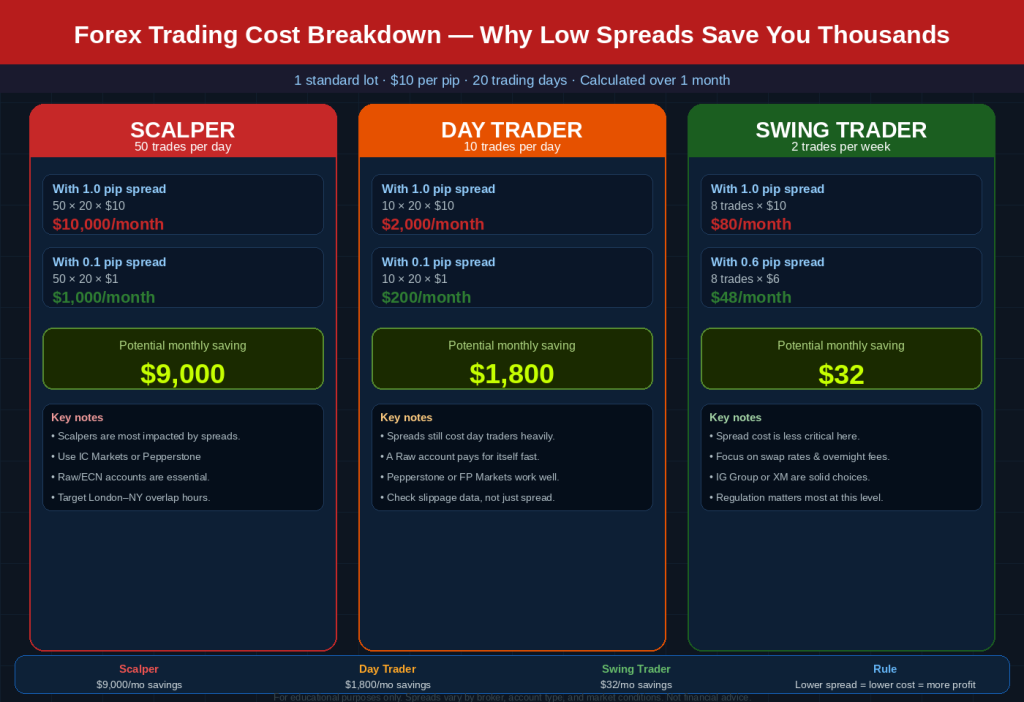
If you're a scalper — someone who enters and exits trades within minutes — you need the tightest spreads possible. Every trade you take needs to clear the spread just to break even. If your spread is 2 pips and your typical trade target is 5 pips, you're giving away 40% of your potential profit before you even start. That's brutal.
If you're a day trader who makes 5 to 10 trades a day, spreads still matter a lot. Let's say you average 1.5 pips spread per trade. Over 200 trading days at 10 trades each, that's 3,000 pips just in spread costs. At $10 per pip on a standard lot, that's $30,000 a year in trading costs. That's not a typo.
Even swing traders who hold positions for days or weeks should care about spreads, though it's less critical for them. When you're targeting 100–200 pip moves, a 1 or 2 pip spread matters less. But it still matters.
The point is — the lower the spread, the lower your cost to trade, and the more of your profits you get to keep. It's that simple.
What to Look for Beyond Just the Spread
Here's something a lot of broker comparison articles won't tell you — spread alone doesn't tell the full story. You need to look at the total trading cost.
Some brokers advertise ultra-low spreads but charge a separate commission per trade. This is especially common with ECN (Electronic Communication Network) brokers. For example, a broker might offer 0.0 pip spreads on EUR/USD but charge $7 per standard lot (round trip). If you do the math, that's actually equivalent to 0.7 pips in cost — which is still very good, but not "zero" as it might appear.
Other things to check include swap rates (the overnight fee for holding positions), slippage (whether your orders get filled at the price you see), execution speed, and whether the broker is dealing desk or no dealing desk. A dealing desk broker can manually intervene in your trades, which is something most serious traders want to avoid.
Regulation is also non-negotiable. Always trade with a broker regulated by a reputable authority like the FCA (UK), ASIC (Australia), CySEC (Cyprus), or CFTC/NFA (USA). An unregulated broker offering 0.0 pips is not worth the risk — ever.
Now, let's get into the actual brokers.
Read: Best Forex Brokers for African Traders (Honest Guide for 2026)
Best Forex Brokers With Lowest Spreads in 2026
1. IC Markets — Best Overall for Raw Spreads
IC Markets is consistently at the top of the list when it comes to low spreads, and for good reason. Their Raw Spread account offers average spreads of 0.0 pips on EUR/USD during peak hours, with a commission of $3.50 per lot per side ($7 round trip). For active traders, this is one of the best deals in the industry.
They're regulated by ASIC (Australia) and CySEC (Cyprus), which gives traders solid protection. Their execution is fast and reliable — they use Equinix data centers and process orders in under 40 milliseconds on average. That matters a lot for scalpers and algorithmic traders.
IC Markets supports MetaTrader 4, MetaTrader 5, and cTrader. If you're someone who uses expert advisors (EAs) or trades with a bot, they're extremely friendly to that style of trading. There are no restrictions on scalping or hedging.
The minimum deposit is $200, which is accessible for most traders. Overall, if you're serious about getting the lowest possible trading costs, IC Markets is hard to beat.
Best for: Scalpers, algorithmic traders, high-volume traders Average EUR/USD spread: 0.0 pips (Raw account) + $7 commission Regulation: ASIC, CySEC
2. Best Forex Brokers With Lowest Spreads: Pepperstone — Excellent Spreads With Top-Tier Execution
Pepperstone is another broker that consistently ranks among the best for tight spreads. Their Razor account offers average spreads of around 0.09 pips on EUR/USD, with a commission of $3.50 per lot per side. That's genuinely tight pricing.
What sets Pepperstone apart from some other low-spread brokers is their customer service and overall user experience. Their support team is responsive, their platforms are stable, and their educational resources are solid for newer traders who are learning the ropes.
They're regulated by the FCA (UK), ASIC (Australia), DFSA (Dubai), and a few other bodies — making them one of the most well-regulated brokers on the list. This gives traders in many countries a high level of fund protection.
Pepperstone also supports MT4, MT5, cTrader, and TradingView integration. If you like using TradingView for charting but want to execute trades directly, Pepperstone is one of the few brokers that makes this seamless.
The minimum deposit is $200. Their spread pricing is competitive at nearly all hours, not just during peak London/New York overlap — which is a genuine plus for traders in different time zones.
Best for: All trader types, particularly those who value regulation and support Average EUR/USD spread: ~0.09 pips (Razor account) + $7 commission Regulation: FCA, ASIC, DFSA
3. FP Markets — Great for Australian and Asian Traders
FP Markets is an Australian broker that's quietly built a reputation for competitive spreads and reliable execution. Their Raw account offers average spreads around 0.0 to 0.1 pips on EUR/USD, with commissions of $3 per lot per side — slightly lower than IC Markets and Pepperstone.
They're regulated by ASIC and CySEC, which is reassuring. FP Markets offers a solid selection of instruments beyond just forex, including stocks, indices, commodities, and cryptocurrencies — so if you like having everything under one roof, this is worth considering.
Their platform selection includes MT4, MT5, cTrader, and IRESS (for shares). The IRESS platform is particularly popular with stock traders, which makes FP Markets a good choice if you want to mix forex with equity trading.
Execution is fast and the broker is known for minimal slippage, even during volatile market conditions. If you're based in Australia or Asia and want a broker that's regulated locally with competitive spreads, FP Markets is definitely worth a look.
Best for: Multi-asset traders, Australian/Asian traders Average EUR/USD spread: ~0.0–0.1 pips (Raw account) + $6 commission Regulation: ASIC, CySEC
4. XM — Best for Beginners Who Still Want Competitive Spreads
XM might not have the absolute tightest spreads of any broker on this list, but they offer an impressive balance between competitive pricing and beginner-friendliness. Their average EUR/USD spread on the Ultra Low account is around 0.6 pips with no commission — which is very reasonable for traders who prefer not to deal with per-trade commissions.
XM is heavily regulated — they hold licenses from FCA (UK), ASIC (Australia), CySEC (Cyprus), and DFSA (Dubai). They're also known for their generous deposit bonuses and no-deposit bonus offerings in eligible regions, which gives new traders a chance to try live trading with reduced risk.
Their educational resources are genuinely excellent. They offer free webinars, video tutorials, and market analysis daily. If you're learning forex trading while also wanting to keep costs manageable, XM gives you that combination.
The minimum deposit is just $5, which is incredibly low and makes XM accessible to traders on tight budgets. The platform selection includes MT4 and MT5.
One thing to note — XM's spreads widen more than some competitors during off-hours and news events. So if you frequently trade at unusual hours, keep that in mind.
Best for: Beginner to intermediate traders, those with small starting capital Average EUR/USD spread: ~0.6 pips (Ultra Low, no commission) Regulation: FCA, ASIC, CySEC, DFSA
5. In Best Forex Brokers With Lowest Spreads OANDA — Best for US and Canadian Traders
If you're in the United States or Canada, your broker options are significantly limited due to strict regulations. OANDA is one of the most reputable brokers available to traders in these regions, and their spreads are competitive given the regulatory constraints of Best Forex Brokers With Lowest Spreads.
OANDA's average EUR/USD spread is around 1.0 to 1.2 pips on their standard account, with no commission. They also offer a "Core Pricing" account in some regions where spreads drop to around 0.5 pips with a small commission added.
What OANDA lacks in spread tightness compared to offshore ECN brokers, they more than make up for in trust and transparency. They're regulated by the CFTC and NFA in the US, FCA in the UK, ASIC in Australia, and several other bodies globally. They publish their spread data and slippage statistics openly — something very few brokers do.
Their proprietary platform is smooth and well-designed, and they also support MT4 for those who prefer it. OANDA also offers fractional lot sizes, which means you can trade with very small position sizes — great for risk management when you're still building your account.
For US and Canadian traders who can't access offshore brokers like IC Markets or Pepperstone, OANDA is the gold standard.
Best for: US and Canadian traders Average EUR/USD spread: ~1.0–1.2 pips (Standard), ~0.5 pips (Core, with commission) Regulation: CFTC/NFA, FCA, ASIC
6. IG Group — Best for Experienced Traders Who Want a Full-Service Broker
IG Group has been around since 1974 — they're one of the oldest and most established brokers in the world. Their spreads on major pairs are competitive, especially if you qualify for their professional account or trade in higher volumes.
On EUR/USD, IG's typical spread is around 0.6 pips with no commission on their standard account. This is decent pricing for a broker of this size and reputation, though it's not the tightest on the list.
Where IG really shines is in their overall offering. They provide access to over 17,000 markets, including forex, shares, indices, options, and more. Their educational content is some of the best in the industry. Their research team publishes daily market analysis that many traders genuinely find useful.
IG is regulated by the FCA (UK), ASIC (Australia), CFTC/NFA (USA via IG US), and many other authorities worldwide. They're one of the very few brokers that US traders can access while still getting institutional-grade features.
If you're an experienced trader who wants tight spreads alongside advanced tools, deep market access, and world-class research, IG Group is a top choice.
Best for: Experienced traders, multi-asset trading, traders who value research tools Average EUR/USD spread: ~0.6 pips (Standard, no commission) Regulation: FCA, ASIC, CFTC/NFA
In Best Forex Brokers With Lowest Spreads How to Compare Spreads Properly
Now that you've seen the brokers, here's how to do your own spread comparison accurately — because spreads can vary a lot depending on when you check them.
First, always look at average spreads rather than minimum spreads. A broker might advertise a 0.0 pip spread, but that might only happen for a few seconds during peak liquidity. The average spread over a full trading day is what actually matters for your bottom line.
Second, factor in commissions. As we mentioned earlier, a broker with 0.0 pips but a $7 commission is actually charging around 0.7 pip equivalent. Compare total trading costs, not just the spread number.
Third, open a demo account and monitor spreads in real time at different hours of the day. Check during the Asian session (low liquidity), the European session (higher liquidity), the London/New York overlap (highest liquidity), and around major news events like Non-Farm Payrolls or FOMC announcements.
Fourth, look at slippage data if the broker publishes it. A broker with a 0.5 pip spread but frequent slippage of 1 pip might actually cost more than a broker with a 1 pip spread and zero slippage. Execution quality is just as important as the quoted spread.
Spread Comparison Table (Major Pairs, Peak Hours)
Here's a quick summary of average spreads on EUR/USD across the brokers we covered:
| Broker | Account Type | Avg EUR/USD Spread | Commission | Best For |
|---|---|---|---|---|
| IC Markets | Raw Spread | 0.02 pips | $7/lot | Scalpers, algo traders |
| Pepperstone | Razor | 0.09 pips | $7/lot | All trader types |
| FP Markets | Raw | 0.0–0.1 pips | $6/lot | Multi-asset traders |
| XM | Ultra Low | 0.6 pips | None | Beginners |
| OANDA | Core Pricing | 0.5 pips | Small fee | US/Canadian traders |
| IG Group | Standard | 0.6 pips | None | Experienced traders |
Note: Spreads fluctuate and may differ from what's shown here. Always verify on the broker's live platform.
Tips to Reduce Your Trading Costs Even Further
Even with the best broker, there are a few habits that will help you keep your trading costs as low as possible.
Trade during peak liquidity hours. The London-New York overlap (roughly 12:00 PM to 4:00 PM UTC) is when spreads are tightest across most major pairs. EUR/USD, GBP/USD, and USD/JPY all tend to have their narrowest spreads during this window. If your schedule allows, try to place most of your trades during this time.
Avoid trading around major news events unless you have a specific news-trading strategy. During events like Non-Farm Payrolls (first Friday of every month), FOMC rate decisions, and CPI releases, spreads can spike dramatically — sometimes 10 to 20 times their normal level. Getting caught on the wrong side of a 5-pip spread spike can wipe out a good portion of your account.
Stick to major currency pairs. EUR/USD, GBP/USD, USD/JPY, AUD/USD, and USD/CHF all have much tighter spreads than exotic pairs like USD/TRY or EUR/ZAR. Unless you have a specific reason to trade exotics, the major pairs will almost always give you a better cost-to-opportunity ratio.
Consider increasing your position size gradually rather than opening many small positions. Every new position you open means paying the spread again. If you're confident in a trade, it can be more cost-efficient to trade a single larger position rather than multiple small ones.
Finally, review your trading journal regularly and calculate your average spread cost per trade. This simple habit keeps you aware of how much you're actually paying in trading costs and pushes you to improve efficiency over time.
Is a Low Spread Broker Always the Right Choice in Best Forex Brokers With Lowest Spreads?
Honestly, not always. And it's worth being upfront about that.
If you're a very casual trader who places 2 or 3 trades a week and holds them for several days, saving 0.5 pips per trade might not be your biggest concern. In that case, factors like platform quality, customer support, education, and the availability of the instruments you want to trade might matter more.
Similarly, if you're interested in trading exotic pairs, indices, or commodities more than forex majors, a broker with a broader market offering might be more valuable than one that simply has the tightest EUR/USD spread.
And if you're just getting started, the best broker for you is probably not the one with the absolute lowest spreads — it's the one that helps you learn, keeps your money safe, and doesn't intimidate you with complicated platforms. XM or OANDA might serve a beginner better than IC Markets, even though IC Markets has lower spreads.
Always match your broker choice to your actual trading style, experience level, and goals.
Final Thoughts On Best Forex Brokers With Lowest Spreads
Finding the best forex broker with the lowest spreads isn't about chasing the smallest number you can find. It's about finding the best total trading environment for the way you trade.
IC Markets and Pepperstone are the top picks for serious, active traders who want raw spreads and fast execution. FP Markets is a great alternative, especially if you want slightly lower commissions. XM is the best starting point for beginners. OANDA is the go-to for US traders. And IG Group is the right fit for experienced traders who want a comprehensive, full-service broker.
Whatever broker you choose, always make sure they're regulated, always test them on a demo account first, and always calculate your total trading cost — not just the headline spread number.
Trade smart, keep your costs low, and let the markets do the rest.
Disclaimer: Forex trading involves significant risk of loss. This article is for informational purposes only and does not constitute financial advice. Always conduct your own due diligence before choosing a broker or making any financial decisions.